
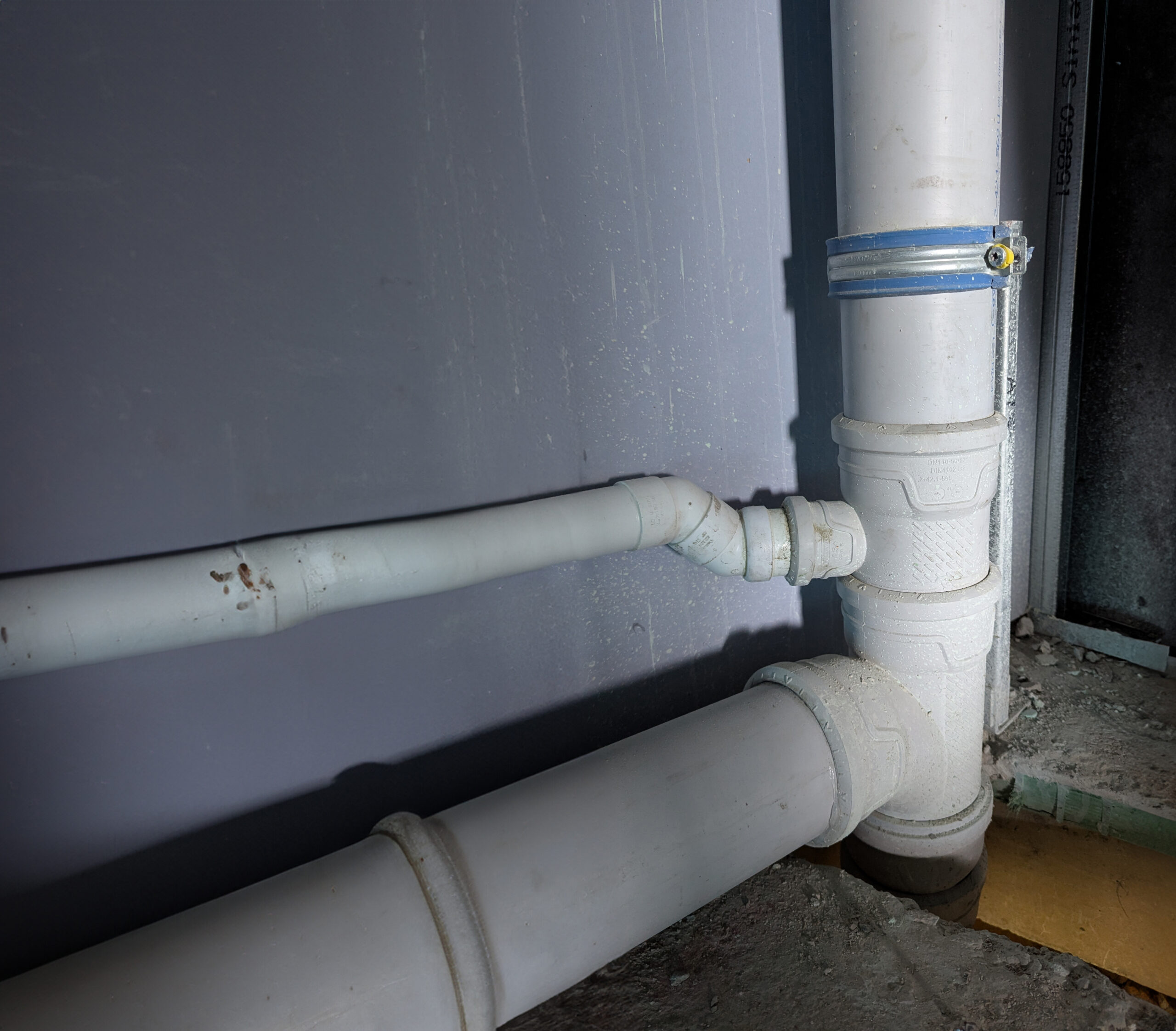
Things that go bump in the pipes: the case for acoustic drainage

Steve Skeldon, Above Ground Product Manager at Wavin explains why great indoor environments increasingly rely on the hidden elements of building services.
It’s no longer just up to architects and designers to build spaces where users are happy, healthy, and productive. Rising expectations for building performance are putting the emphasis on everyone involved in a project, including installers, engineers, and contractors. While shared responsibility is a positive development, user experience depends on both visible and invisible factors, requiring input from multiple disciplines.
Acoustic performance is a case in point here. Its role in a new breed of building certifications, focused on far more than embodied carbon, is already significant and keeps growing. As buildings are asked to do more across the board, they’re increasingly being asked to do it quietly, because there is no doubt about the value a quiet and comfortable acoustic environment delivers for occupants.
A not-so-silent health risk
The emphasis on acoustic performance in new buildings and refits is partly explained by the fact that these projects are entering an ever-noisier world. New research by the European Environment Agency has revealed that more than 110 million people in Europe suffer from high levels of noise pollution and that this is damaging their health.
The report finds that 66,000 early deaths a year result from the physiological stress and sleep disturbance caused by living with excessive noise pollution. Similar work by the UK Health Security Agency found that 40% of the UK were exposed to harmful transport noise.
To say the fight against noise pollution is an uphill struggle would be an understatement, but it is at least one where the built environment can make a difference.
Well-insulated indoor spaces, where everyone on the project is using their skills to create a quiet and calm environment, can be effective sanctuaries against the effects of noise pollution in the outside world.
Given the scale of the challenge, marginal gains make a huge difference when trying to keep the volume down indoors, particularly in the urban areas where noise pollution is at its worst. For installers and engineers, this means effective sound insulation of plumbing and mechanical installations – a loud plumbing or drainage system shouldn’t compromise a carefully designed acoustic environment.
These trades are now being asked to consider acoustics from the very beginning of their work on a project and use it to guide product and installation processes, often crafting a specific strategy for each project.
Knowledge is power
Effective handling of acoustics in plumbing and drainage systems requires a different skillset. Installers and specifiers don’t need to become sound engineers, but an understanding of how sound travels through a building is essential to choosing right system for a project and ensuring it is built correctly.
In plumbing systems, sound can disturb occupants in two primary ways:
- Airborne noise generated by water moving through pipes
- Structure-borne noise resulting from vibrations transmitted from pipework into walls and floors
The right strategy will insulate against both these sources at the specification and installation stages. However, it also needs to consider the use case for the room on the other side of the wall – quiet is more important in bedrooms and office spaces, for example, than in utility rooms or kitchens. This is crucial for directing budget and time towards areas where acoustic protection will deliver the maximum value possible.
Regulation is another element to keep any eye on. Public buildings, hotels and hospitals are subject to noise standards designed to protect the health and wellbeing of occupants, and, in these cases, awareness of the plumbing system’s acoustic contribution is about more than best practice.
In the UK, Approved Document E of the Building Regulations requires that residential dwellings provide reasonable resistance to sound from bathrooms in other rooms. It’s also worth considering the EN14366 standard, which governs how the sound level emitted by drainage products is measured. This test setup itself is by no means perfect, because it assumes a constant water flow, so doesn’t consider noise created by sudden water flow caused by flushing toilets, for example. It underlines the scale of the challenge that installers and engineers have on their hands when designing and specifying systems that protect peace and quiet.
Answers from manufacturers
There has been significant work from manufacturers to make it an easier job, with systems designed specifically with acoustics in mind. Low-noise, high-density piping materials are what make the difference here, helping to minimise the airborne noise generated by water flow.
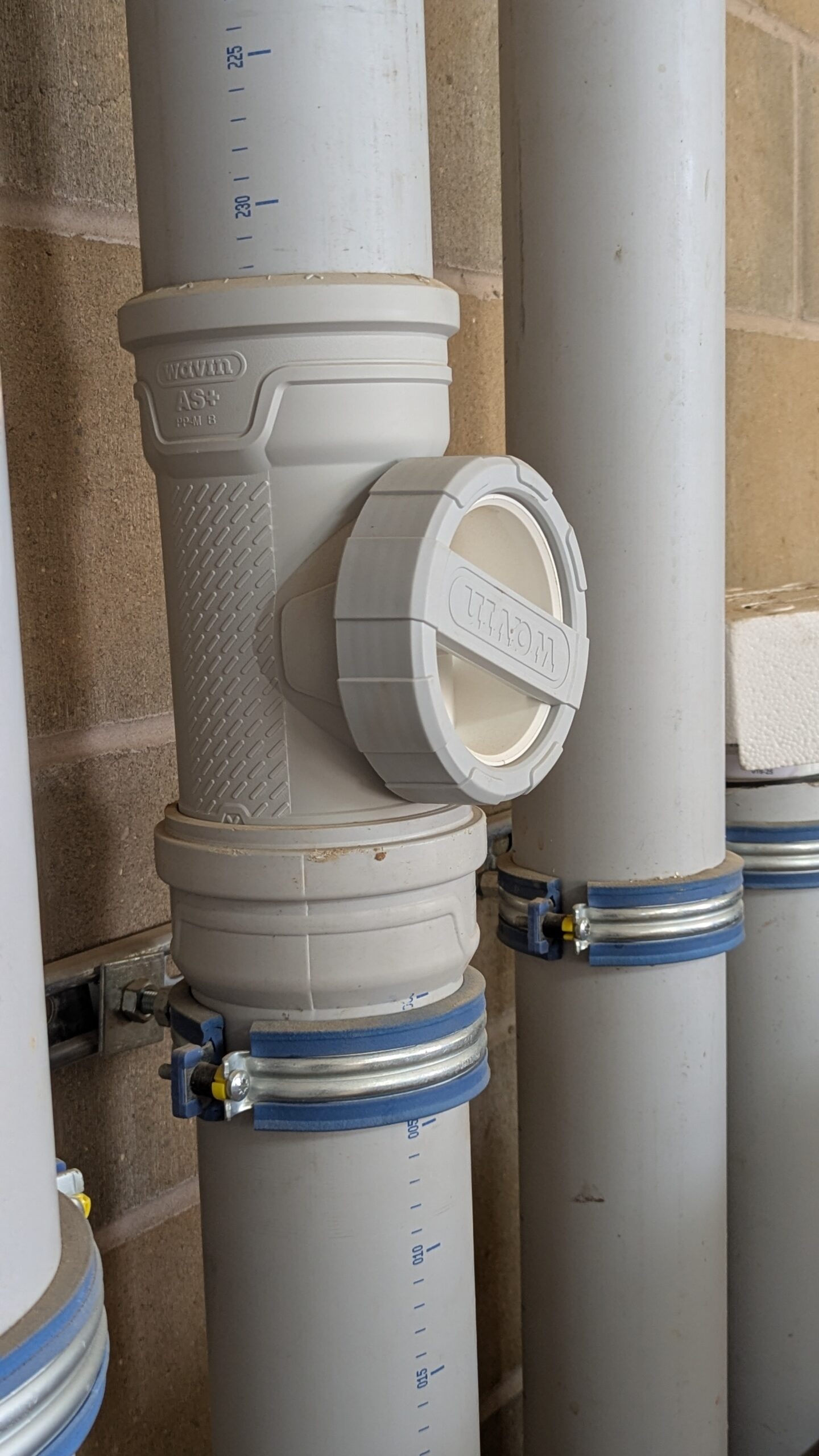
These systems are designed to absorb vibrations, rather transfer them onto other surfaces and into spaces used by occupants. Wavin’s AS+ is one example, a high mass and wall thickness, low elastic modulus, and specially-designed brackets are made to target potential sources of sound and minimise their impact.
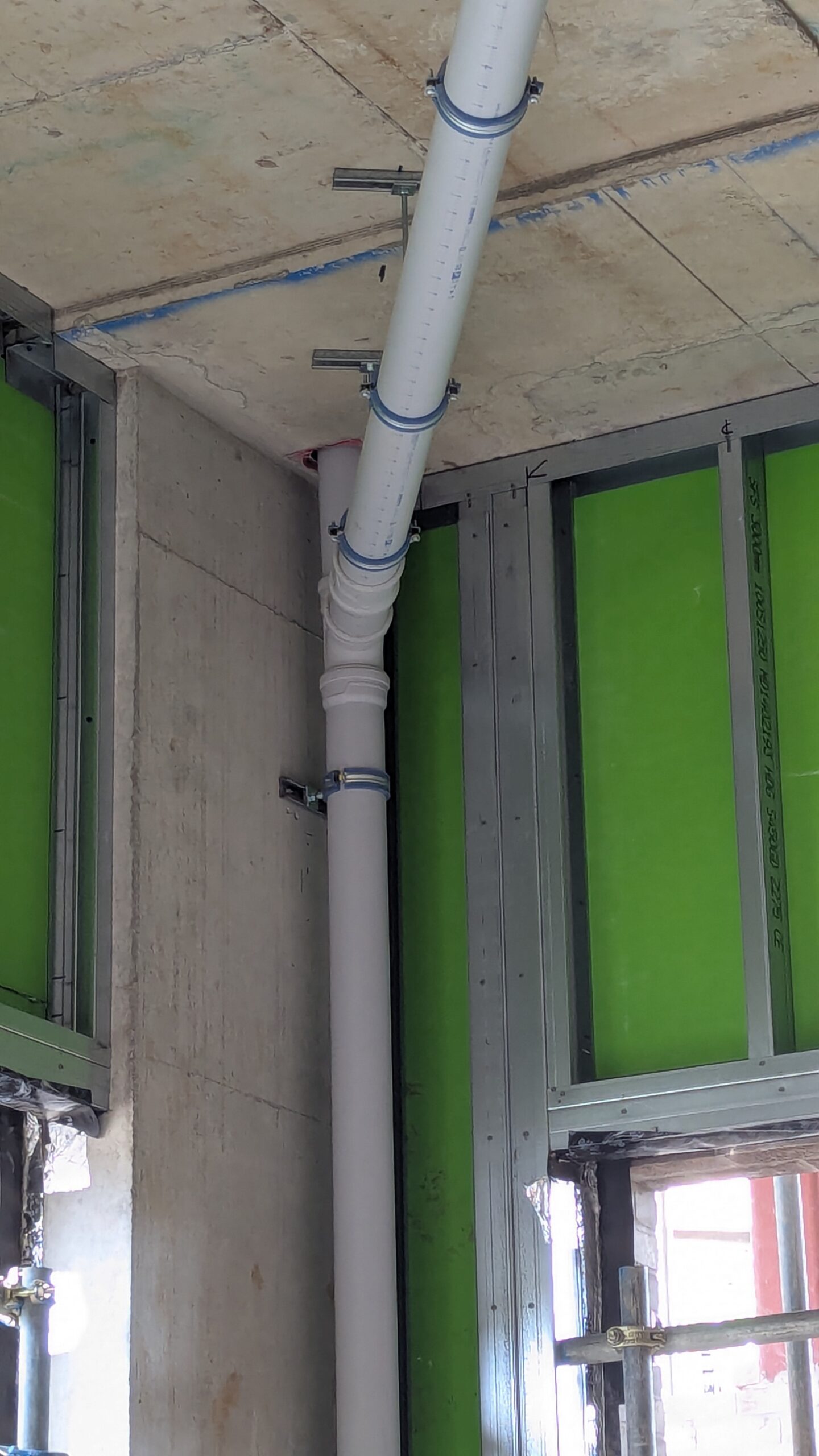
However, even the smartest of products needs to be installed right, and there are specific steps that need to be taken with acoustics in mind to ensure these systems do the job. Installers should ensure pipes are properly supported to prevent vibrations from being transmitted to the rest of the structure. Brackets also need to be decoupled from walls with elastic inserts, while vertical stacks should be securely fixed with the correct spacing.
Brackets in general need a special approach from an acoustics perspective. A two-bracket system is the best option, with a fixed bracket beneath a floor slab and a sliding bracket above.
This keeps everything stable while allowing for thermal expansion and contraction without unnecessary noise and without structure-borne noise travelling vertically through the building.
The nature of sound waves makes collaboration on acoustic performance essential between contractors. Different trades need to work together to ensure that the good work done by one contractor isn’t undone by the team that follows. It’s a tall order, but a culture of sharing expertise between manufacturers, installers, designers and specifiers will flatten the learning curve for everyone.
The sound of silence
It’s no surprise that acoustic performance is now a pillar of healthy and sustainable building certifications – everyone has struggled when working, sleeping, or relaxing in spaces without proper noise insulation. As the outside world gets louder, expectations for buildings are on the rise, and they’re bringing those for plumbing and drainage systems with them.
It’s a serious challenge for those charged with specifying and installing these systems, but the solutions are out there from manufacturers, as is the guidance for installation and testing. The emphasis on acoustics will only increase, and it is professionals with the skills and the tools for the job who will be able to cut through the noise.