
Smarter heating for hospitals and schools

Gareth Ash, Marketing Manager at Danfoss, explores how targeted adjustments can significantly reduce carbon emissions in buildings, and why optimising the flow of energy remains one of the most powerful opportunities for improving performance.
Energy efficiency has become a critical focus for building services engineers as commercial buildings face increasing operational demands, rising energy prices, and tightening sustainability targets. Improving the way commercial buildings use and manage energy is now recognised as one of the most effective routes to reducing carbon emissions and long-term running costs.
Within this landscape, health and education estates stand out as particularly energy-intensive. The NHS is the UK’s largest single public energy user, with annual energy costs exceeding £1.4 billion1 , more than doubling since 2019. When combined with schools, these institutions account for around 70% of energy consumption2 across the public sector’s property portfolio. As the UK accelerates toward net-zero commitments, estate managers in these environments are under growing pressure to modernise infrastructure and drive meaningful efficiency improvements.
Optimising a building’s HVAC system alone can reduce energy use by an average of 22% per building, often achieving payback within just two years.

Hydronic balancing plays a crucial role in achieving these efficiency gains. By ensuring that water used for heating is evenly and efficiently distributed throughout a building, hydronic balancing guarantees that each radiator or heating circuit receives precisely the right amount at the right time. This avoids overheating in some rooms and underheating in others.
Despite this, more than 80% of the UK’s existing heating systems are poorly balanced, leaving vast potential for improvement. This is particularly critical in hospitals and schools, where maintaining stable indoor temperatures directly supports patient wellbeing, pupil concentration, and overall comfort. In these environments, older systems often struggle to deliver consistent temperatures across multiple floors or wings, leading to cold spots, wasted energy, and increased operational costs.
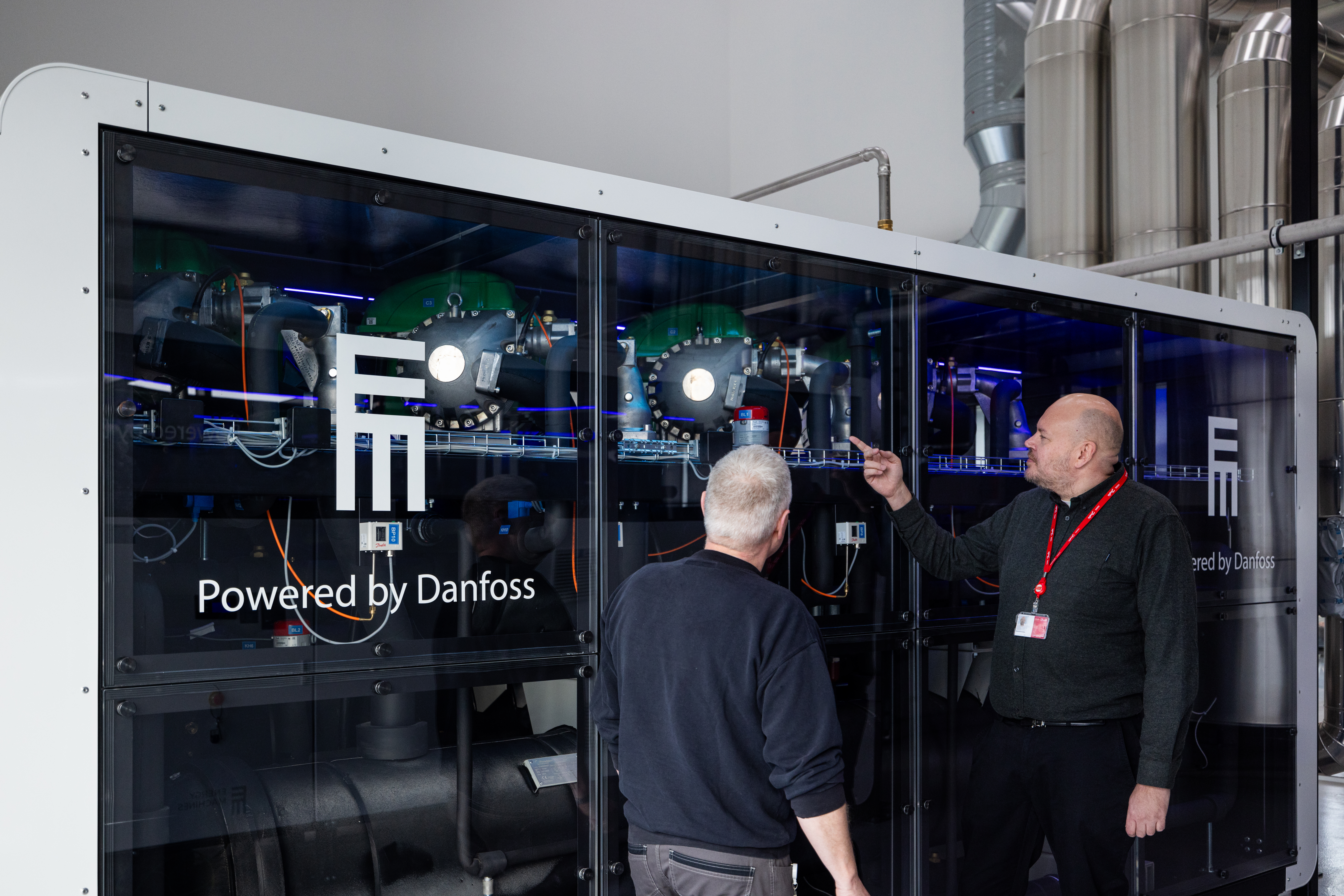
Across Europe, forward-thinking hospitals are already demonstrating what can be achieved by modernising outdated systems. At Sygehus Sønderjylland in Sønderborg, Denmark, new state-of-the-art technology from Danfoss Climate Solutions has enabled the hospital to respond to the energy crisis with confidence.
The site is replacing its old gas boilers with two modern heat pumps supported by multiple Danfoss components that balance heating and cooling systems effectively. Alongside improved comfort and reduced energy costs, the hospital will also become an energy provider. This example illustrates how strategic HVAC upgrades can strengthen resilience and protect patient care even during periods of inflation and energy volatility.
Static balancing: Tried, tested, and cost-effective
Static hydronic balancing uses manual balancing valves combined with mechanical radiator thermostats set for full-load conditions to regulate and maintain the flow at the set value. It is a straightforward solution ideally suited to systems where the building load is relatively stable and predictable. Static balancing is great for retrofitting hospitals and schools where radiator valves without pre-setting functionality may already be installed.
However, while cost-effective, static systems do not adapt to fluctuating heating demands, making them inefficient during partial load conditions (spring and autumn). Nevertheless, where the heating load is well understood, static balancing offers a good balance of performance and cost.
Dynamic balancing: precision under varying loads
Dynamic hydronic balancing addresses the limitations of static systems by maintaining consistent flow rates even when demand fluctuates. Using pressure-independent control valves (PICV) or differential pressure controllers, dynamic balancing ensures that each radiator or circuit receives the required water to deliver optimal performance under full or partial load conditions.
Achieving this requires control at the terminal unit level, which can be challenging in retrofit projects where system drawings may be outdated or incomplete. Nevertheless, implementing dynamic hydronic balancing using pressure-independent control valves can significantly improve the energy efficiency of commercial buildings.
To fully optimise a heating system, real-time information about system performance is essential.
Building operators need transparency regarding energy flows and an efficient means of adapting the system to changes in usage patterns or building design. Digitalising the actuators is key to achieving this level of control, enabling a move towards intelligent, energy-efficient buildings.
Benefits of modulating room temperature control
Modulating room temperature control further enhances efficiency. Stable temperatures improve comfort perception while allowing reductions in heating setpoints or increases in cooling without compromising comfort. Variable flow systems, commonly used in commercial buildings, adjust water flow based on load, improving energy efficiency but complicating balancing.
This is where advanced pressure-independent control solutions such as the Danfoss AB-QM valve make a significant difference. It combines a control valve and a differential pressure controller in a single unit, automatically absorbing pressure fluctuations while accurately determining the actual flow. The design flow is set as a percentage of the maximum flow, reducing the control valve stroke and ensuring fully pressure-independent flow control with an authority of 100%. This approach maintains precise flow at every terminal unit under all operating conditions, and enables highly stable room temperatures, maximising comfort and energy efficiency simultaneously.
HVAC 4.0 in smart buildings
Reliable and accurate pressure-independent control valves are the enablers of HVAC 4.0 in smart buildings. When integrated with digital actuators, hydronic HVAC systems can be fully controlled via Building Management Systems, providing real-time data for active energy management. Remote access enables predictive maintenance and continuous commissioning, reducing operational costs and laying the foundation for long-term energy efficiency.
Digitalisation also delivers advanced temperature control, flexibility during refurbishment, time savings during installation and commissioning, and targeted, predictive maintenance, all of which contribute to cost savings over the lifecycle of the building.
By embracing dynamic hydronic balancing and digitalised control, building operators can achieve measurable reductions in energy consumption, optimise system performance, and position their estates to meet both current efficiency targets and future sustainability goals.
References
2.
The correlation of energy performance and building age in UK schools – ScienceDirect